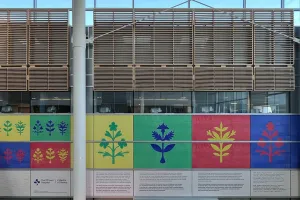
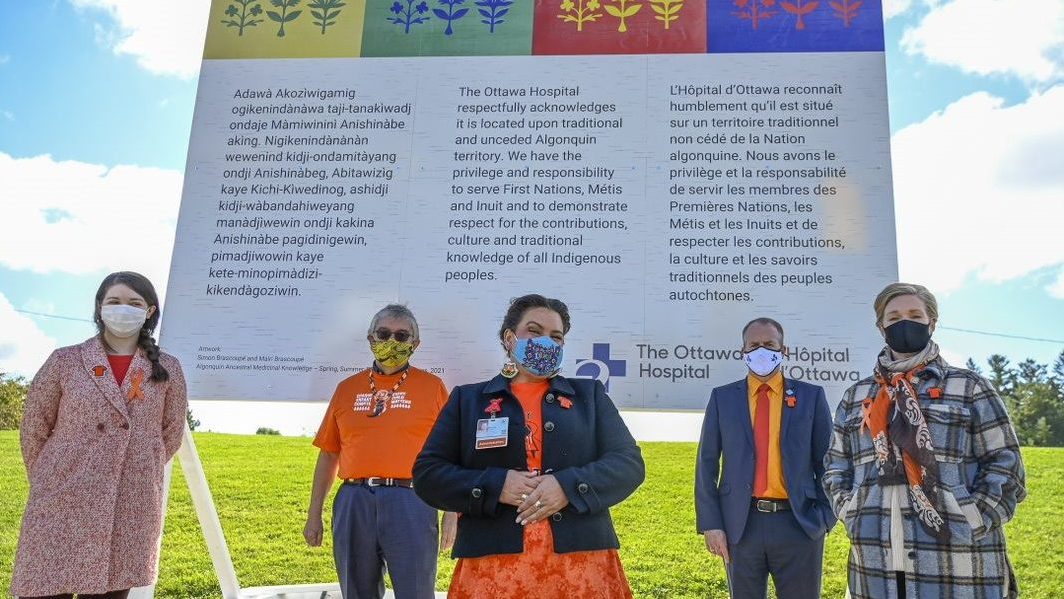
Original artwork by Simon Brascoupé and Mairi Brascoupé presented at the land acknowledgement ceremony for the new Civic development

Mairi Brascoupé (left) and Simon Brascoupé standing in front of the land acknowledgement sign that features their original artwork.
The next time you’re near the site of the new Civic Development where Champagne Ave. meets Carling, look for a large sign adorned with four brightly-coloured silhouettes of medicinal plants. The artwork is by world-renowned Kitigan Zibi Anishinabeg artist Simon Brascoupé and his daughter, Mairi Brascoupé,
“The series Algonquin Ancestral Medicinal Knowledge honours Algonquin knowledge of medicinal plants passed down through the generations from our ancestors,” explained Simon. “The medicinal plant images are inspired by ancient Algonquin birchbark cut outs used as templates for decorating birchbark baskets and in museum collections around the world.”
This print series was created using Risograph printing technique which perfectly reproduces the texture of printing on birchbark paper. The Risograph is a unique technology from Japan that combines the vibrant colours of silkscreen with efficiency, affordability and low-energy usage.
Part of a momentous occasion
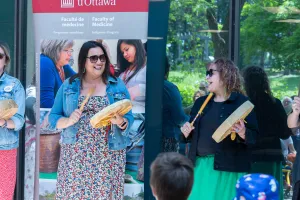
The artwork was presented during a ceremony at the site of the new Civic development to mark Canada’s first National Day for Truth and Reconciliation, also known as Orange Shirt Day, and to honour the land and respectfully offer thanks for the contributions, culture and traditional knowledge of all Indigenous Peoples.
“Indigenous patients who come to this new hospital – and indeed any patient who comes to any one of TOH’s campuses – should feel they are in a space where they will be respected, where their values and beliefs are at the core of their treatment and healing, and where they are treated with dignity and compassion,” said Katherine Cotton, Chair of The Ottawa Hospital’s Board of Governors. “It is our collective responsibility to ensure that this is a reality for every patient every time.”
As well as serving patients from Eastern Ontario, the hospital is the tertiary referral centre for patients from Nunavut.
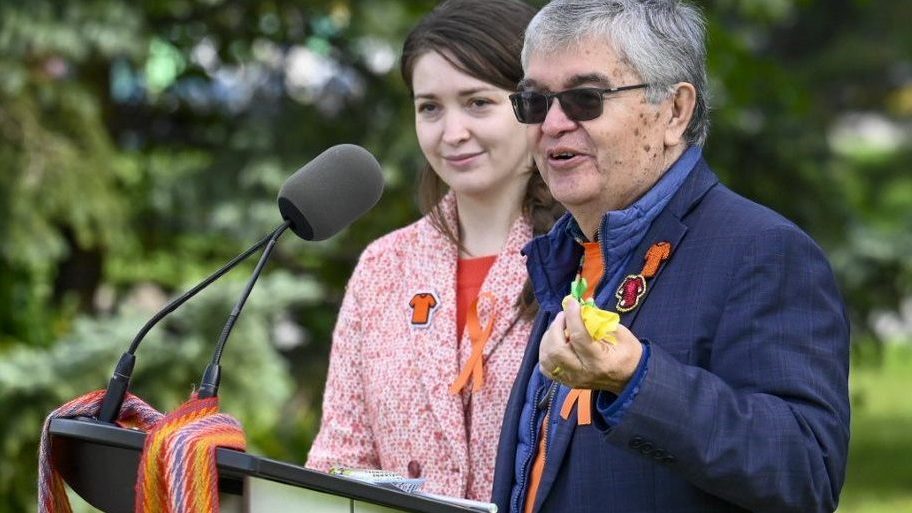
For Simon, the moment also had a deeply personal significance.
“You think back three generations—parents, grandparents, great-grandparents—and then you think forward—children, grandchildren, great-grandchildren—and the land acknowledgement brings that home to me. We were standing on Algonquin territory and everywhere in this territory my ancestors have walked,” he said.
Contributing to culturally safe spaces
Simon and Mairi authorized use of this artwork to the hospital in part because they believe it will help create a culturally safe space.
“One way to make a culturally-safe space for Indigenous peoples is to include symbols of Indigenous culture,” said Simon. “So when people come in they recognize their art from their community, and that helps contribute to the safe space.”
Art as identity, family, connection
In addition to helping to create a culturally safe public space, Simon reflects on how creating art has been a lifelong, deeply personal affair.
“Since I was a very young child, I knew I was an artist, so art is part of me.” he said. “It’s my responsibility to express myself through art because it’s part of my own identity.
It’s an identity that he shares with his children.
“It’s funny,” he said. “I’m surprised that a lot of my children are artists and I shouldn’t be. It’s a joyous thing. It warns my heart. It’s an expression of love that we have for each other, and when we are doing art, we are doing this together.”
And that togetherness is equally important to Mairi.
“We always talk about intergenerational trauma, but there’s also intergenerational knowledge sharing,” she said. “And through the process of our work, we try to share with each other, both the traditional knowledge and artistic knowledge, and that’s what is encompassed in this work.”
So whenever you see those silhouettes of four medicinal plants at the construction site or in the new campus when it opens in 2028, know that it’s the product of love between a father and daughter, a symbol of inclusion and a colourful connection to ancestors past, present and future.